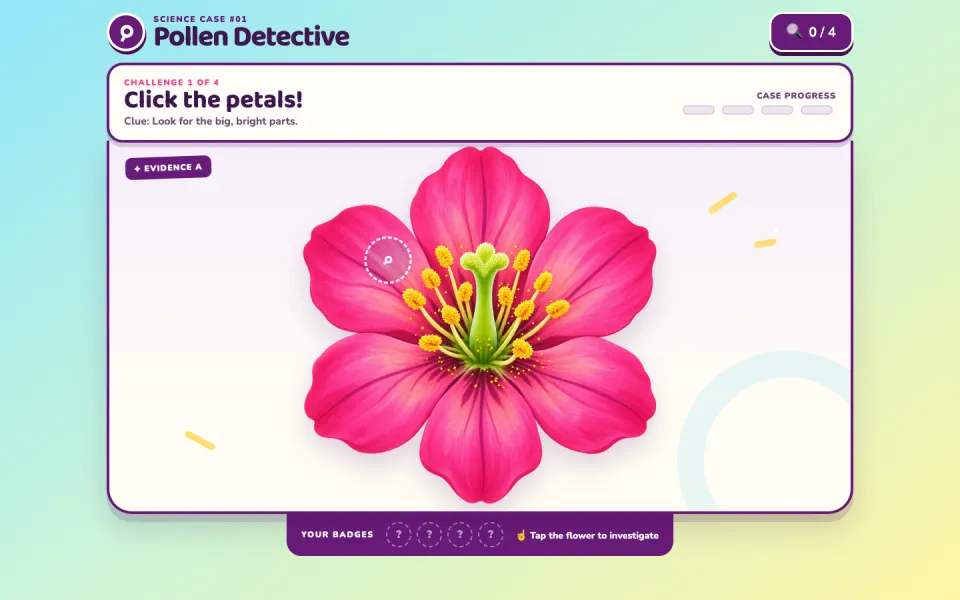
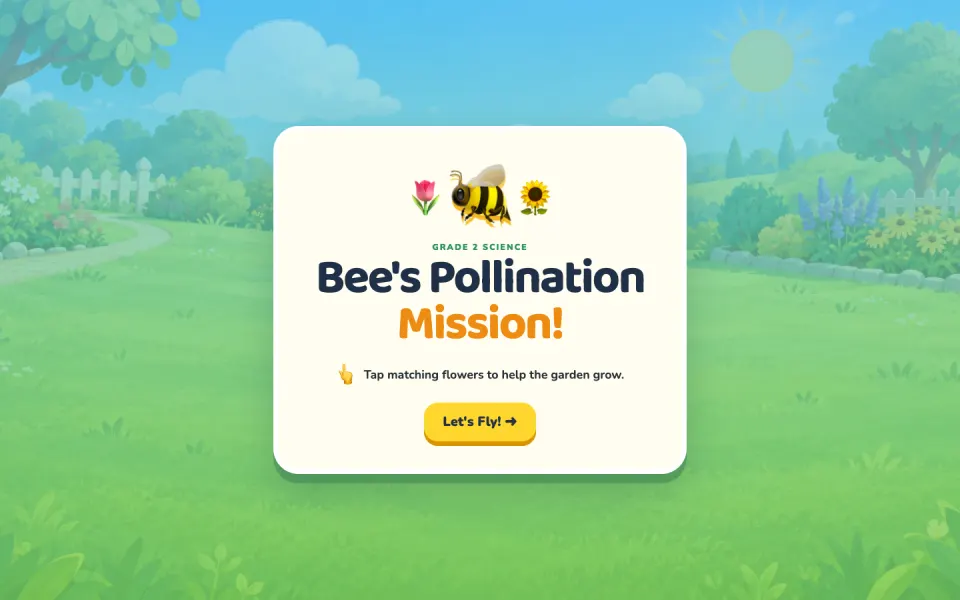
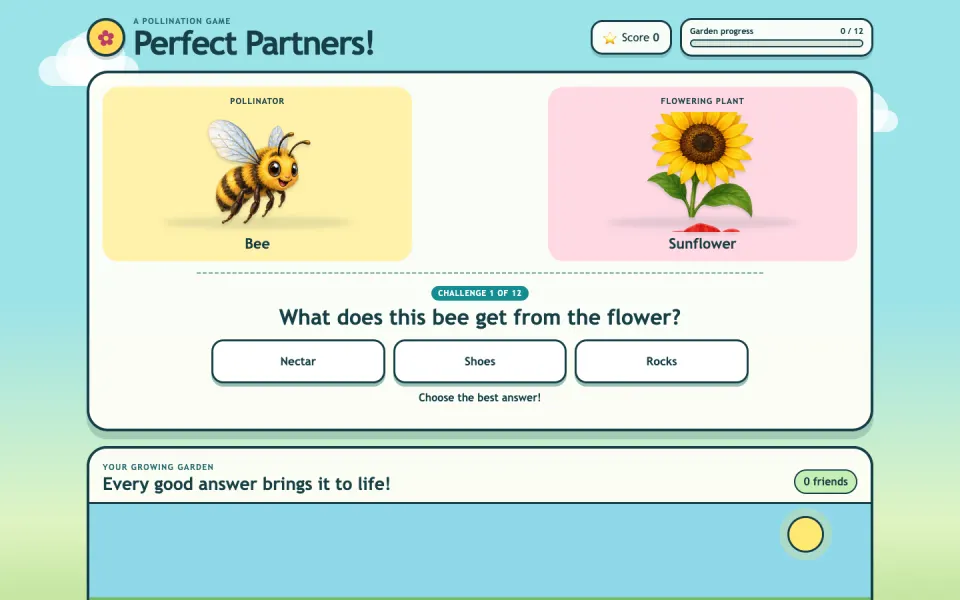
Seven curriculum-aligned games designed to reinforce the Plants & Pollinators learning sequence through purposeful interaction and immediate practice.
The challenge
Starting with a real educational need.
The design challenge was to turn key Plants & Pollinators concepts into age-appropriate interactions that reinforced instruction rather than distracting from the learning objectives.
Design objectives
Reinforce plant structures and scientific vocabulary.
Practise plant life-cycle sequencing.
Apply understanding through environmental decisions.
Observe both usability and learning evidence as part of a wider sequence.
Design approach
Process and decisions
01Define curriculum-linked learning objectives
02Match game mechanics to the intended learning
03Prototype seven interactions with Codex
04Use each game after its related instructional content
05Observe navigation and learner response
06Review follow-up project work
07Identify design improvements
Play the games
Seven standalone learning experiences
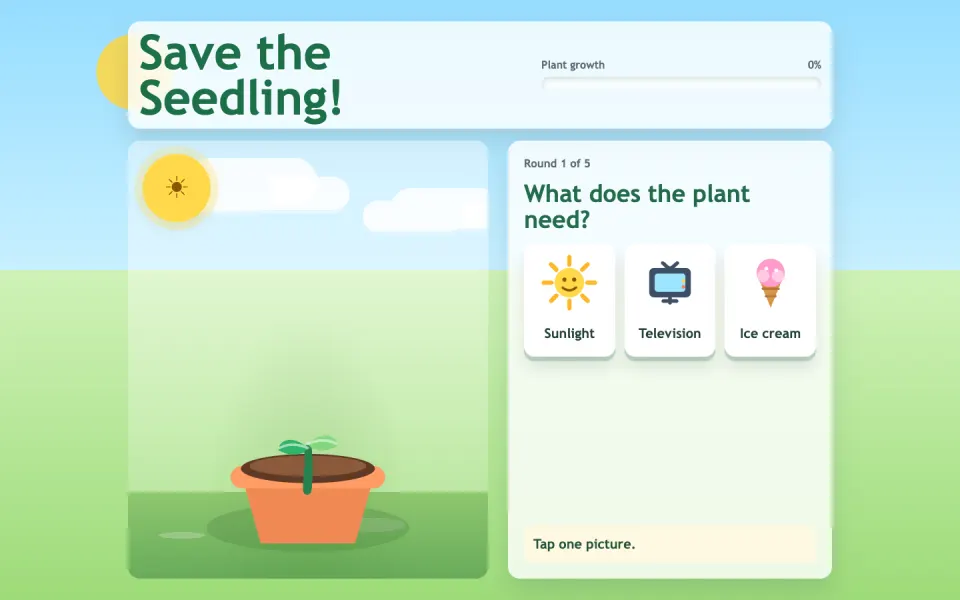
Explore seven interactive games designed for a Grade 2 Plants and Pollinators unit. Each uses active participation and feedback to support a specific learning objective.
Featured games
Grade 2 · Plants and Pollinators
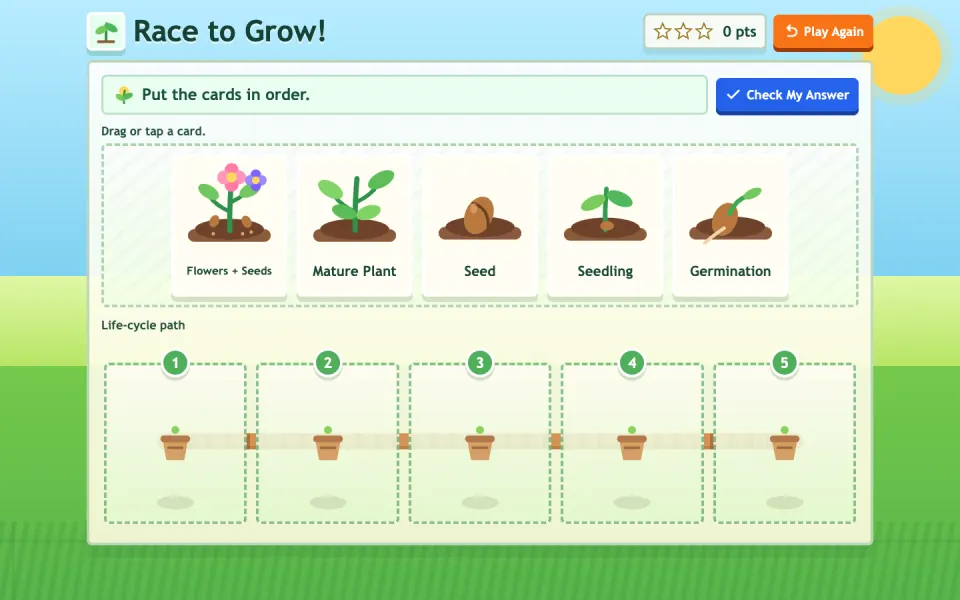
Race to Grow
Learning objective
Sequence the stages of a flowering plant life cycle.
Interaction
Drag or tap stage cards into order, then identify a missing stage.
Feedback
Answer checking highlights stages that need revision before a completion sequence.
Design rationale
Sequencing makes the cyclical relationship between seed, growth, flowering and new seeds visible.
Each game opens independently in a new browser tab. No login or personal information is required.
Classroom implementation
Observation across the wider learning sequence.
The seven games were used with 11 Grade 2 students from 14 to 18 September 2026, after the corresponding instructional content on a Promethean display.
Engagement observations
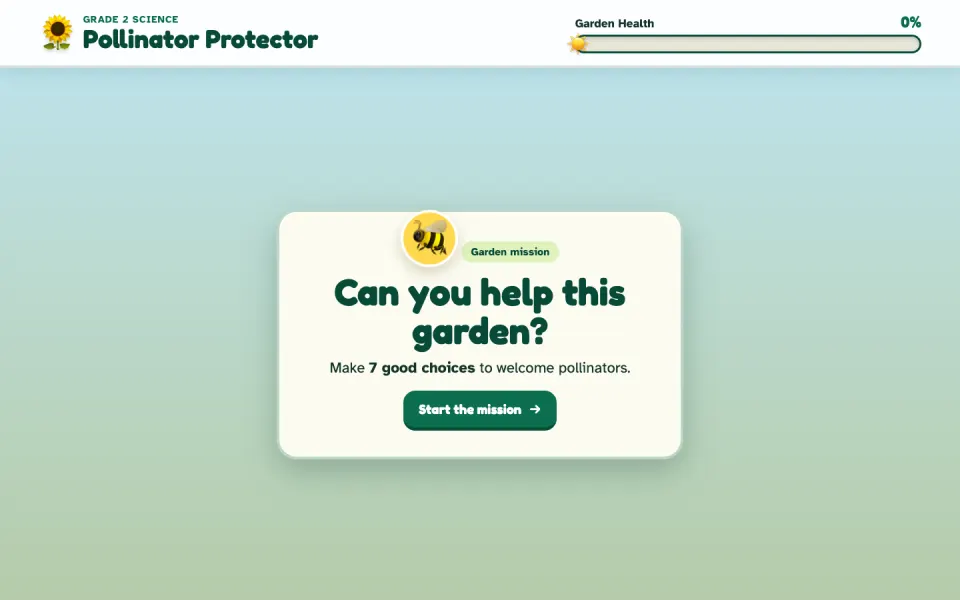
Students were enthusiastic; Race to Grow and Pollinator Protector generated particularly strong interest and requests to replay.
Usability observations
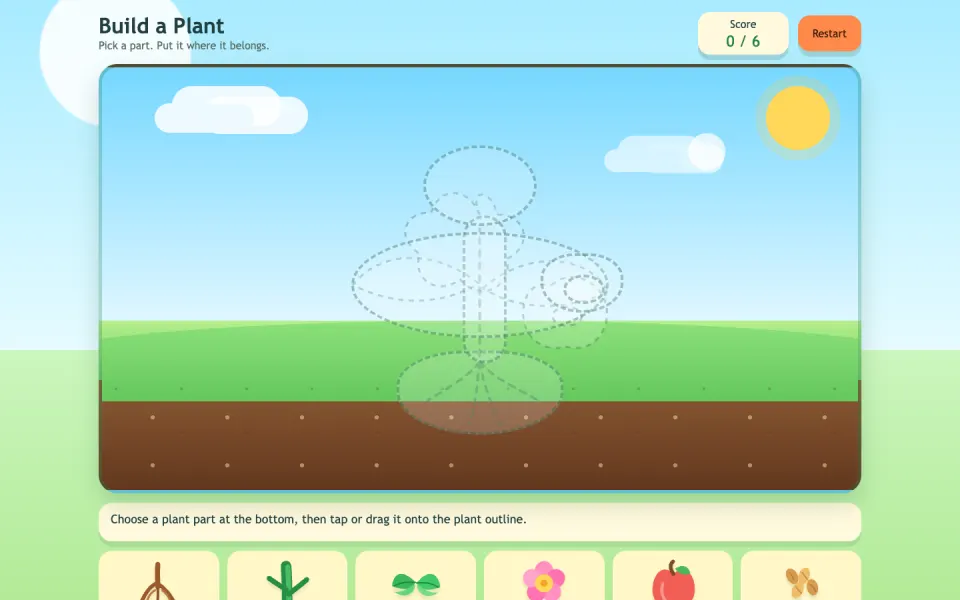
Navigation was generally successful. Seed placement in Build a Plant revealed a need for clearer guidance or more intuitive controls.
Learning evidence
Follow-up booklet work provided evidence from the complete sequence of direct teaching, discussion, games and project work.
Learning evidence
9 / 11
students demonstrated clear understanding in follow-up work
Approximately 82%. This reflects the complete instructional sequence—not the games in isolation.
Evaluation and Evidence
Follow-up evidence came from a Plants & Pollinators project booklet; two students found it difficult to recall the functions of plant parts.
Engagement observations and learning evidence were considered separately.
Limitations
The small classroom group does not support generalised conclusions.
The instructional sequence included slides, discussion, games and project work, so causation cannot be attributed to the games.
More systematic usability data would strengthen the evaluation.
Reflection
Strong engagement is valuable, but it is not a substitute for evidence of learning.
Age-appropriate interaction design matters: a small control issue can become a barrier to demonstrating understanding.
Additional scaffolding is needed where learners still struggle with the function of plant parts.
Future improvements
Redesign seed placement in Build a Plant.
Add clearer scaffolded feedback for plant-part functions.
Collect structured observation data in a future implementation.
Continue structured accessibility and usability testing across desktop and tablet interactions.
Supporting evidence
Case study documents
Open the formatted PDF case study and supporting source material.